Research program · FB1
The FB1 Research Program
A lossless 12‑byte encoding for human flatulence
Why we set out to store a fart in twelve bytes, how we did it, what we found, and what remains unsolved.
1C 85 C2 39 00 4E 2C 24 15 01 06 C1
Abstract
Human flatulence is among the most widely produced and least formally described sounds in everyday life. It is customarily stored as raw audio, which is bulky, unsearchable and, in our view, disrespectful to the subject. We present FB1, a fixed-length encoding that describes a complete flatulent event in exactly 12 bytes. On a representative event it achieves a reduction of roughly 9,000 to one against uncompressed WAV, and about 51,000 to one in a cathedral. The encoding is deterministic, fits in a text message, and never passes through a server. The silent case remains open.
The FB1 Research Series
Seven short films, 7 minutes in all. Watch them in order.
-
Part 1 · 1:01
Why We Did It
A single fart, saved as a sound file, takes up 107,800 bytes. The program begins by asking whether that is necessary.
Transcript
Every day, humanity produces billions of these.
And when one is worth keeping, we save it the way we save everything else. As a sound file.
That fart, just over one second long, takes up 107,800 bytes.
A longer one, in a big echoey cathedral, takes over 600,000.
Stored this way, a fart is bulky. You can't search it. You can't describe it. And frankly, it's disrespectful to the subject.
Yet anyone who hears one can describe it in a few words. How long. How high. How forceful. Wet, or dry. And what it was sitting on.
So we asked a simple question. If a person can describe a fart in a few words, can a computer store it in a few bytes?
The answer turned out to be twelve.
Hear the result for yourself, at fartbytes.com.
-
Part 2 · 1:05
Compressionless Compression
Instead of squeezing the recording, FB1 keeps no recording at all. It writes down the recipe.
Transcript
Most compression works by squeezing.
You take a recording, and throw away the parts nobody will miss. That's how an MP3 works.
Squeezed into an MP3, this fart still takes about 21,000 bytes.
We tried something different. Compressionless compression.
We don't squeeze the recording. We don't keep the recording at all.
We write down the recipe instead. Nine dials, one room, and a random number. Twelve bytes in all.
When you press play, the fart is cooked fresh, from scratch, right in your browser.
The same recipe makes the same fart, every time, on every device.
12 bytes, instead of 107,800. That's about 9,000 to one.
A long one in a cathedral does even better. About 50,000 to one.
Nothing was squeezed. Nothing was lost. Because nothing was kept.
Compressionless compression. Try it at fartbytes.com.
-
Part 3 · 1:16
The Method
Seven recordings, about 320 flaps, nine dials, a draining tank of gas and five modeled rooms.
Transcript
Every good study starts with data. Ours started with seven real fart recordings, all in the public domain.
We cut them into single flaps. About 320 of them.
Each flap is one tiny puff of vibration, about a hundredth of a second long.
Then we asked: what makes one fart different from another?
We boiled it down to nine dials. Length. Pitch. Force. Roughness. Wetness. Sputter. Muffle. Bend. And breath.
Next, we modeled the gas itself, as a tank that drains as it goes. When the pressure drops too low, the tone stops, and only air gets through.
Finally, the setting. We modeled five rooms. Open air. A wooden chair. A bathtub. An elevator. And a cathedral.
Each one adds its own sound. Here's the wooden chair.
It rings at about 165 and 410 hertz. Amplified, unfortunately.
Put it all together, and every fart in the system fits in 12 bytes. Build your own at fartbytes.com.
-
Part 4 · 1:01
What It Means for Humanity
For most of history a fart lasted about a second. In 12 bytes it can be kept, sent, named and catalogued.
Transcript
For most of history, a fart lasted about a second. And then it was gone.
Today, that changes.
In 12 bytes, a fart can be kept forever, in less space than this sentence.
It can be sent across the world in a text message. It plays the same on every phone. And it never passes through a server.
It can be named. Every recipe gets its own name. The Mighty Foghorn in the Elevator. The Squelchy Duck in the Elevator. The elevator has seen a lot.
And it can be catalogued. There are about 1.5 billion billion billion possible farts. So far, we've catalogued eleven.
Of course, there is more work to do. The format still can't handle the silent ones. We consider this the most important open problem in the field.
Until then, the future of the fart is in your hands. Make one. Send it to a colleague. fartbytes.com
-
Part 5 · 0:55
The Silent Ones
The most important open problem in the field, and our closest attempt at it.
Transcript
Every field has its unsolved problem. Ours is the silent one.
Every fart in our system is built from sound. Tiny flaps of vibration, and a little air.
But some farts make no sound at all. And yet, everyone in the room knows.
Here is our closest attempt. A preset called Silent But Deadly.
Not silent.
So we turned the breath dial all the way up. The tone stopped completely.
Unfortunately, the air did not. With the tone gone, it actually got louder.
Our 12 bytes describe everything you can hear. Not one of them describes the part you can't.
We consider this the most important open problem in the field. If you can solve it, the lab is open. fartbytes.com
-
Part 6 · 1:14
The Sputter
Why the end of a fart is the hardest part to model, shown with the pressure trace.
Transcript
Every fart has a beginning, a middle, and an end. The end is where things fall apart.
In our model, the gas lives in a tank, which drains as the fart goes on.
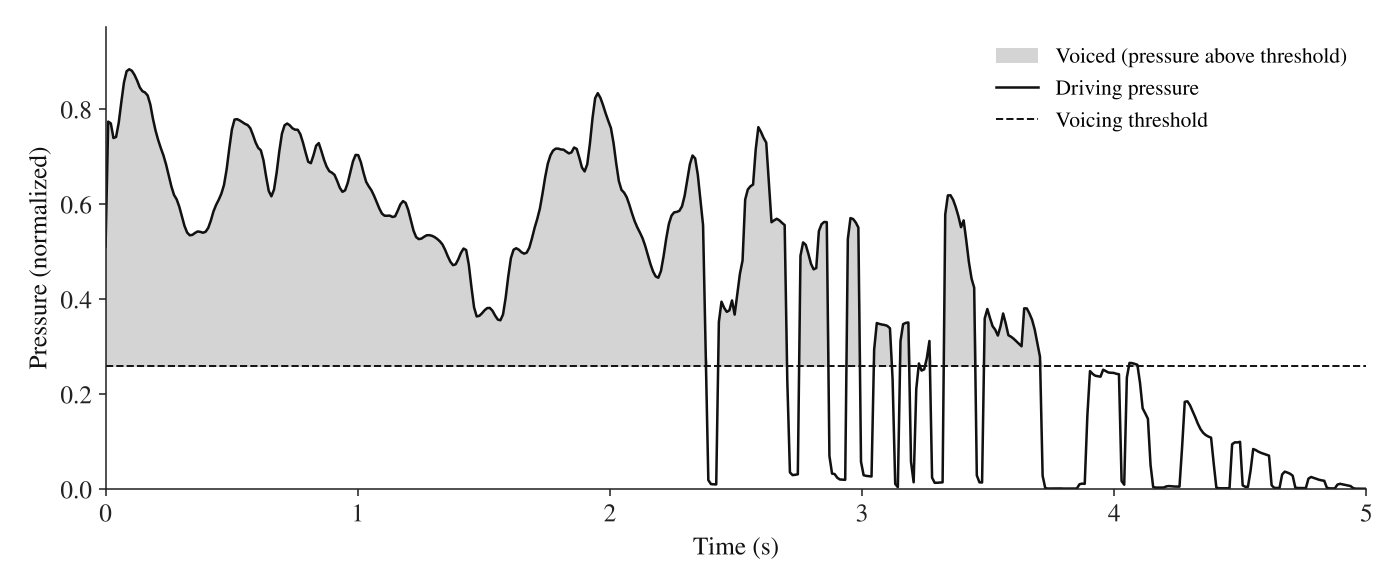
Near the end, the flow starts switching on and off, in bursts a few hundredths of a second long. We call this the sputter.
The sputter dial decides how early the breakup starts. Turned nearly all the way up, it takes over most of the fart. This is Machine Gun.
Now, the same long fart, twice. First, with no sputter.
Then with the sputter dial at 60 percent.
With no sputter, the tone holds for 93 percent of the fart. With sputter, 68.
And as the pressure nears the line, the pitch gets shakier, and the whole thing tapers away.
Pressure, timing, tremble and release, all at once. That's why, in our model, the end is the hardest part.
Hear how yours ends, at fartbytes.com.
-
Part 7 · 0:50
Peer Review
The program answers its critics. Is this science? Who asked? Has it been peer reviewed?
Transcript
Since we published, our research has faced some tough questions. Today, we answer them.
Is this science? We built a working synthesizer, a published format, and a white paper. We'll let you decide.
Why? Farts are shared constantly, and described poorly. Usually in a single adjective.
Who asked? Nobody. That has never stopped science before.
Is it reproducible? Yes. The same 12 bytes make the same fart, on any device, every time.
Where's the data? Seven public domain recordings. And a free sound library, at fartbytes.com/sounds
Has it been peer reviewed? It's being reviewed right now. You're the peer.
Submit your findings at fartbytes.com.
A note on the narration: the narrator is an AI-generated voice, made with Kokoro, an open-source text-to-speech model. Every sound in the series was rendered by the lab's own engine from public-domain recordings. The series is also published as Shorts on YouTube.
1Motivation
Every day, humanity produces billions of flatulent events. When one is worth keeping, it is saved the way everything else is saved: as a sound file. A single event of just over one second, recorded on a wooden chair, occupies 107,800 bytes as a WAV. A longer one in a cathedral occupies 612,508.
Stored this way, a fart cannot be searched, compared or described. It can only be replayed. General-purpose codecs make it smaller but no more understood: MP3 treats a fart exactly as it would treat a cello. MIDI has no vocabulary for wetness. The closest prior art is the whoopee cushion, which offers a single fixed preset.
We considered this an unacceptable state of affairs for a sound of such universal reach.
2Origin of the idea
The program began with an observation. Anyone who hears a fart can describe it in a few words: how long it was, how high, how forceful, wet or dry, and what it was sitting on. No one describes it sample by sample.
This suggested a simple research question. If a person can describe a fart in a few words, can a computer store it in a few bytes?
It also suggested a method we have come to call compressionless compression. Conventional compression squeezes a recording and discards what the listener will not miss. We do not squeeze the recording. We do not keep the recording at all. We write down the recipe, and the fart is prepared fresh, from scratch, in the listener's browser, every time it is played.
The answer to the research question turned out to be twelve.
3Method
Data. The study began with seven real recordings, all in the public domain. We cut them into single flaps, about 320 in all. A flap is one puff of vibration, roughly a hundredth of a second long, and is the basic unit from which every event is built. Flaps are re-timed and re-pitched with PSOLA to suit the event being described.
Parameters. We then asked what makes one fart different from another, and reduced the answer to nine physical parameters of one byte each.
| Parameter | 0 | 255 |
|---|---|---|
| Duration | blip | saga |
| Tension | tuba | piccolo |
| Pressure | whisper | thunder |
| Rasp | smooth | motorboat |
| Wetness | bone dry | consult a doctor |
| Sputter | clean exit | machine gun |
| Muffle | commando | jeans and a sofa |
| Bend | sad trombone | question? |
| Breath | all voice | silent but deadly |
Tension sets pitch on an exponential scale from 38 Hz to about 350 Hz.
The gas. We modeled the gas as a tank that drains as the event goes on. While the driving pressure stays above a threshold, the flap vibrates and the event has tone. Below it, only air passes.
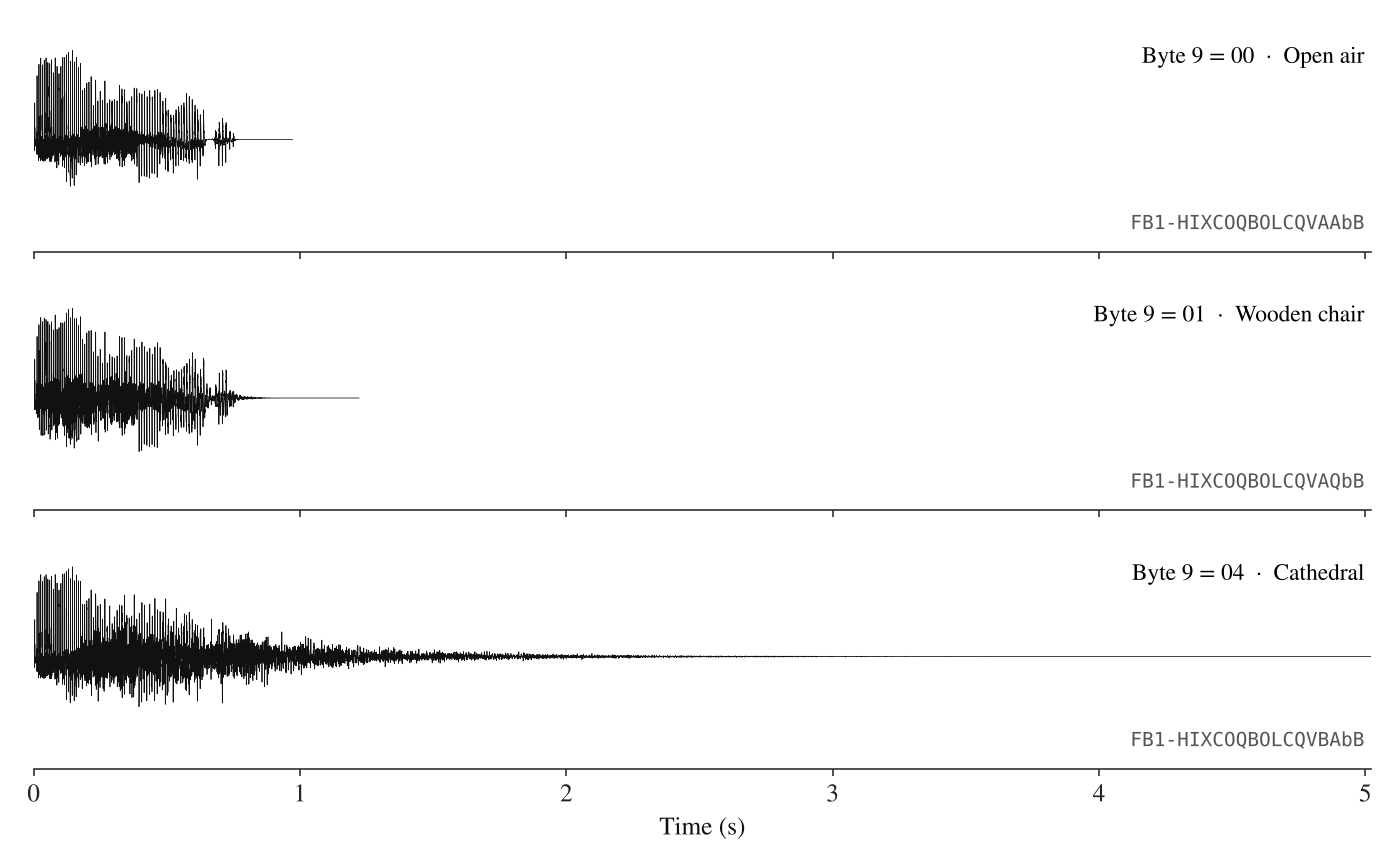
The setting. Finally, we modeled five rooms, because an event cannot be separated from where it happens: Open air (no witnesses), Wooden chair (amplified, unfortunately), Bathtub, Elevator (nowhere to hide) and Cathedral. The wooden chair resonates at about 165 and 410 Hz. The cathedral has a reverberation time of 3.8 seconds.
The code. An FB1 code holds the nine parameters, one byte for the room and a 16-bit random seed, so that two events with identical parameters are not identical sounds, just as in life. The twelve bytes are written in base64url behind a version tag, giving a 20-character code such as FB1-HIXCOQBOLCQVAQbB that fits in a link, a text message or a meeting invite.
4Results
Compression. Our worked example, Board Meeting, decodes to 1C 85 C2 39 00 4E 2C 24 15 01 06 C1: short, firm, high-pressure and bending downward, on a wooden chair. Its wetness byte is exactly zero. As a WAV it occupies 107,800 bytes. FLAC, the leading lossless alternative, needs 53,420. MP3 needs about 21,000. FB1 needs 12, a reduction of roughly 9,000 to one.
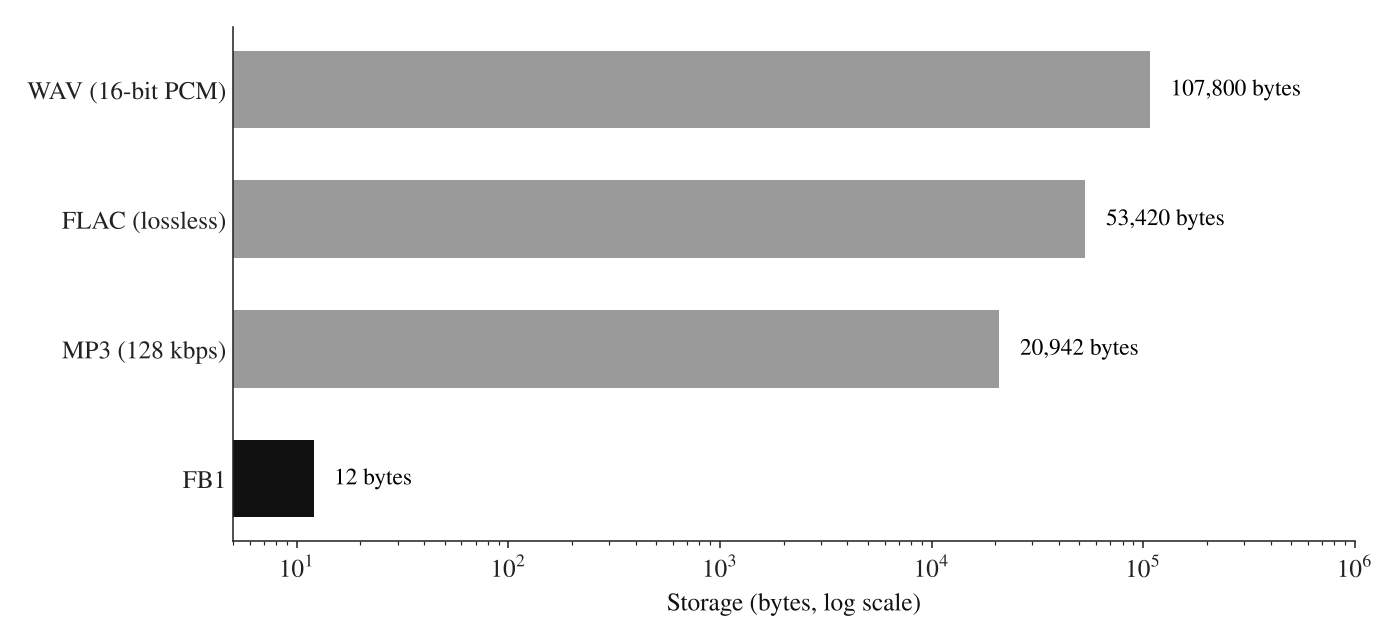
The most efficient case is Sunday Service, where 598 KB of WAV is mostly cathedral echo. FB1 stores that echo in a single byte, a reduction of about 51,000 to one.
The room. Changing one byte moves an event to a different room. In the cathedral, the event outlasts its cause by roughly four seconds.
The sputter. Near the end of a long event the flow switches on and off in bursts a few hundredths of a second long. The sputter parameter decides how early this breakup begins. With no sputter, The Long Goodbye holds its tone for 93 percent of its length; with the sputter at 60 percent, for 68 percent. At the setting used by the specimen Machine Gun, the breakup covers the last 86 percent of the event.
Reproducibility. The same twelve bytes produce the same fart on every device, every time. Because the code travels in the fragment of the link, it is decoded in the listener's browser and never reaches a server.
Nomenclature. Every code yields a deterministic name, such as The Classic Motorboat on the Wooden Chair or The Mighty Foghorn in the Elevator, which allows events to be discussed in meetings without playback.
Coverage. The format can express about 1.5 × 1027 distinct events. To date we have catalogued eleven. All eleven are available, free and in the public domain, in the sound library.
5Limitations and open problems
The silent ones. Every event in our system is built from sound. Some events make no sound at all, and yet everyone in the room knows. Our closest attempt is the specimen Silent But Deadly, which is not silent. With the breath parameter at its maximum the tone stops completely, but the air does not, and the result is about 30 percent louder. Our twelve bytes describe everything that can be heard. Not one of them describes the part that cannot. We consider this the most important open problem in the field.
The ending. Pressure, timing, tremble and release all change at once in the final moments of an event. In our model, the end remains the hardest part.
The lab is open to anyone who can do better.
6Responses to reviewers
- Is this science?
- We built a working synthesizer, a published format and a white paper. We will let you decide.
- Why?
- Farts are shared constantly and described poorly, usually in a single adjective.
- Who asked?
- Nobody. That has never stopped science before.
- Is it reproducible?
- Yes. The same 12 bytes make the same fart on any device, every time.
- Where is the data?
- Seven public-domain recordings, and a free sound library.
- Has it been peer reviewed?
- It is being reviewed right now. You are the peer.
7Publications and materials
- FB1: A Lossless 12-Byte Encoding for Human Flatulence
The white paper. Free to read.
- The Super Fart Lab
The working synthesizer. Nine sliders, five rooms. Make an event and send its code to a colleague.
- The sound library
Eleven catalogued specimens as WAV files, public domain, no credit needed.
- The FB1 Research Series
Seven narrated films, above, with transcripts.
How to cite
Super Fart Lab. FB1: A Lossless 12-Byte Encoding for Human Flatulence. The FB1 Research Program, 2026. https://fartbytes.com/research/
Fart Bytes · Super Fart Lab · Sound library · No cookies, no sign-up, no ads.